Kubernetes Hosting vs Dedicated Hosting: Complete Comparison
December 18, 2025 by Adam


December 18, 2025 by Adam


Choosing the right hosting infrastructure is a critical decision for modern businesses, SaaS founders, DevOps teams, and agencies managing performance-driven applications. Two common options often compared are Kubernetes hosting and dedicated hosting. While both serve powerful workloads, they are built for very different use cases, scalability models, and operational needs.
Dedicated hosting has long been trusted for predictable performance and full hardware control. It provides a single physical server exclusively allocated to one customer, making it suitable for legacy systems and compliance-driven environments. Kubernetes hosting, on the other hand, represents the cloud-native approach—designed around containers, automation, and elastic scalability.
As applications shift toward microservices, CI/CD pipelines, and global availability, understanding the real differences between Kubernetes hosting and dedicated hosting becomes essential. The choice affects cost efficiency, reliability, deployment speed, operational overhead, and long-term scalability.
This guide offers a clear, side-by-side comparison of Kubernetes hosting and dedicated hosting, covering performance, security, cost, use cases, and hosting considerations. It is designed to help decision-makers confidently choose the infrastructure that aligns with both current requirements and future growth.
Kubernetes hosting refers to an infrastructure model where applications run inside containers managed by Kubernetes, an open-source container orchestration platform originally developed by Google. Instead of relying on a single server, Kubernetes distributes workloads across a cluster of nodes, ensuring high availability, scalability, and automation.
At its core, Kubernetes organizes applications into pods, which are the smallest deployable units containing one or more containers. These pods run across multiple nodes inside a Kubernetes cluster. The platform automatically manages container scheduling, resource allocation, service discovery, load balancing, and failure recovery.
One of the biggest advantages of Kubernetes hosting is auto-scaling. When traffic increases, Kubernetes can automatically spin up additional containers. When demand drops, it scales down—optimizing resource usage and reducing costs. This makes it ideal for SaaS platforms, APIs, eCommerce applications, and microservices-based architectures.
Kubernetes also includes self-healing capabilities. If a container crashes or a node fails, Kubernetes automatically replaces it without manual intervention. Combined with rolling deployments and zero-downtime updates, this significantly improves reliability.
Kubernetes hosting can run on public cloud platforms, private infrastructure, or container-based managed hosting environments, such as RoconPaas, where each application runs in isolated containers with consistent performance. This container isolation provides both security and stability without the overhead of managing raw servers.
Typical use cases for Kubernetes hosting include:
For organizations prioritizing agility, automation, and scalability, Kubernetes hosting represents the modern standard.
Dedicated hosting is a traditional infrastructure model where a single physical server is assigned exclusively to one customer. Unlike shared or VPS hosting, all CPU, RAM, storage, and network resources are fully dedicated, offering predictable performance and complete control over the server environment.
With dedicated hosting, organizations can customize hardware configurations, install specific operating systems, configure security policies, and manage workloads without sharing resources with other tenants. This makes it appealing for enterprises running monolithic applications, legacy software, or workloads requiring strict compliance controls.
Performance in dedicated hosting is stable because resources are fixed. However, scalability is limited. Scaling usually involves provisioning new servers, migrating data, and manually configuring infrastructure—often leading to downtime or operational complexity.
Dedicated servers are commonly used in:
Security is another strength. Since the server is physically isolated, there is no risk of “noisy neighbors.” However, security maintenance—including patching, firewall configuration, and monitoring—remains the responsibility of the user or hosting provider.
While dedicated hosting offers full control, it lacks automation. Updates, backups, failover strategies, and scaling typically require manual intervention or additional tooling. This increases operational overhead compared to Kubernetes environments.
In modern infrastructure discussions, dedicated hosting is increasingly viewed as stable but rigid—best suited for workloads that do not require rapid scaling or continuous deployment pipelines.
Choosing between Kubernetes hosting and dedicated hosting requires looking beyond surface-level differences. While both models deliver performance and control, they approach scalability, reliability, cost, and operations in fundamentally different ways. This section breaks down each critical feature to help businesses understand which infrastructure best aligns with modern application demands.
Kubernetes Hosting:
Kubernetes hosting is designed for dynamic, elastic performance. Instead of relying on a single server, Kubernetes distributes workloads across a cluster of nodes. Containers automatically scale up or down based on real-time metrics such as CPU usage, memory consumption, or incoming traffic. This ensures applications remain fast and responsive even during sudden traffic spikes.
Dedicated Hosting:
Dedicated hosting provides consistent, predictable performance by allocating an entire physical server to a single application or user. While this setup offers full hardware control and stability, performance is limited to the server’s fixed capacity. Scaling requires manual hardware upgrades or provisioning new servers, often leading to configuration changes, service interruptions, and increased infrastructure costs. This makes dedicated hosting less adaptable to changing workload demands.
Comparison Takeaway:
For applications with fluctuating demand—such as SaaS platforms, APIs, or content-heavy websites—Kubernetes hosting provides far greater performance flexibility than dedicated servers.
Kubernetes Hosting:
Kubernetes hosting is designed with high availability at its core. It continuously monitors containers and nodes, automatically detecting failures and rescheduling workloads to healthy resources. If a container crashes or a node becomes unavailable, Kubernetes restores services without manual intervention. This self-healing capability minimizes downtime and ensures applications remain accessible even during infrastructure failures.
Dedicated Hosting:
Dedicated hosting relies on the availability of a single physical server. While uptime can be reliable under normal conditions, hardware failure creates a single point of risk. Achieving high availability requires manual configuration of redundancy, failover servers, and load balancers—adding complexity and cost to the infrastructure.
Comparison Takeaway:
Kubernetes hosting delivers built-in resilience and fault tolerance, making it ideal for applications that demand continuous uptime. Dedicated hosting can be reliable but requires significant manual effort to match Kubernetes-level availability.
Kubernetes Hosting:
Kubernetes hosting supports exceptional flexibility through containerization. Applications run consistently across development, staging, and production environments, as well as across hybrid and multi-cloud setups. This portability allows teams to move workloads with minimal changes, enabling faster experimentation and innovation.
Dedicated Hosting:
Dedicated hosting environments are tightly coupled to specific hardware and operating system configurations. Migrating applications often involves reconfiguration and testing, which slows down deployment cycles and limits agility.
Comparison Takeaway:
For teams prioritizing rapid development and future-proof infrastructure, Kubernetes hosting offers far greater agility than dedicated hosting.
Kubernetes Hosting:
Kubernetes integrates seamlessly with CI/CD pipelines, enabling automated deployments, rolling updates, and zero-downtime releases. These automation capabilities reduce human error and support continuous delivery at scale, making Kubernetes ideal for DevOps-driven teams.
Dedicated Hosting:
Dedicated hosting typically relies on manual deployment processes. Updates require direct server access, service restarts, and careful coordination—leading to longer release cycles and increased risk during updates.
Comparison Takeaway:
Kubernetes hosting accelerates deployment speed and reliability through automation, while dedicated hosting remains dependent on manual processes.
Kubernetes Hosting:
Kubernetes uses a layered security approach, including role-based access control (RBAC), namespace isolation, network policies, and container-level security. Each workload operates in an isolated environment, reducing the impact of potential security breaches.
Dedicated Hosting:
Dedicated hosting offers physical isolation, as the server is not shared with other users. However, security depends heavily on manual server hardening, patch management, and monitoring, which increases administrative responsibility.
Comparison Takeaway:
Kubernetes provides scalable, policy-driven security controls, while dedicated hosting relies more on hands-on security management.
Kubernetes Hosting:
Kubernetes optimizes infrastructure costs by dynamically sharing resources across workloads. Businesses pay only for what they use, avoiding idle capacity and reducing long-term operational expenses—especially in container-based environments like RoconPaas.
Dedicated Hosting:
Dedicated hosting often results in over-provisioning, where resources are paid for regardless of actual usage. Hardware upgrades and maintenance further increase the total cost of ownership over time.
Comparison Takeaway:
Kubernetes hosting delivers better cost efficiency for growing or variable workloads, while dedicated hosting is more cost-effective only for stable, predictable usage.
Kubernetes Hosting:
Kubernetes reduces operational overhead through automation. Tasks such as scaling, monitoring, failover, and updates are handled automatically, allowing teams to focus on application development instead of infrastructure maintenance.
Dedicated Hosting:
Dedicated hosting requires ongoing system administration, including server updates, backups, and performance tuning. This increases operational workload and staffing requirements.
Comparison Takeaway:
Kubernetes hosting significantly lowers day-to-day operational effort, making it ideal for lean teams and agencies managing multiple applications.
| Feature | Kubernetes Hosting | Dedicated Hosting |
| Performance | Dynamic, auto-scaled across clusters | Fixed to server hardware |
| Scalability | Automatic horizontal scaling | Manual server upgrades |
| High Availability | Built-in self-healing and failover | Requires manual redundancy |
| Deployment | CI/CD, rolling updates, zero downtime | Manual deployments |
| Flexibility | Portable across clouds and environments | Hardware and OS dependent |
| Security | RBAC, container isolation, network policies | Physical isolation, manual security |
| Cost Efficiency | Pay-for-use, optimized resources | Over-provisioned fixed costs |
| Operational Overhead | Low due to automation | High ongoing maintenance |
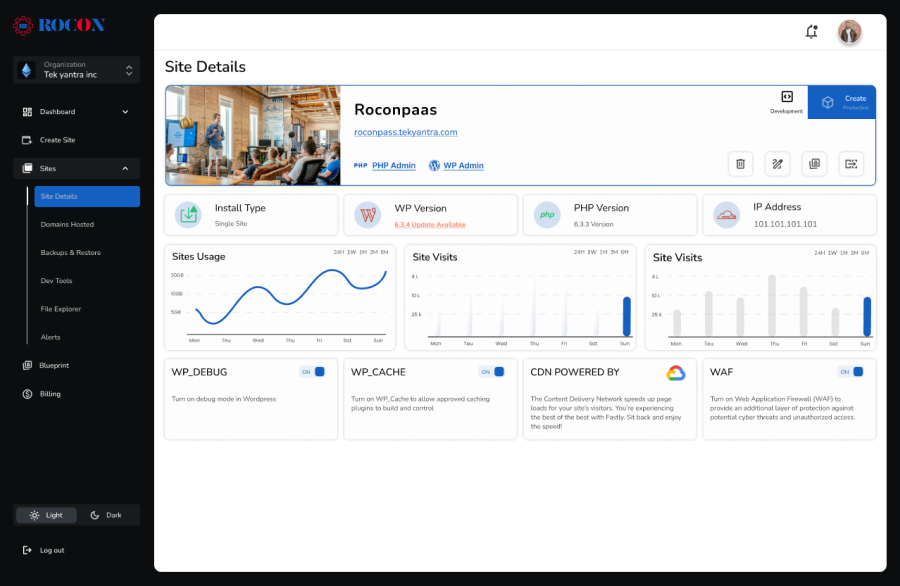
RoconPaas offers managed WordPress hosting powered by Kubernetes, allowing businesses, agencies, and developers to host websites on container-based infrastructure. This modern hosting approach ensures scalability, high availability, and performance optimization, making it ideal for websites that experience variable traffic or manage multiple client projects. With RoconPaas, managing multiple WordPress sites becomes effortless through an intuitive dashboard designed for organizations and agencies.
Kubernetes-powered hosting at RoconPaas distributes your website workloads across containers, automatically scaling resources based on traffic or demand. This ensures consistent performance during peak loads without manual intervention. Whether you’re running a high-traffic blog, an e-commerce store, or client websites, container-based hosting provides the flexibility to handle growth seamlessly.
RoconPaas offers a centralized dashboard that allows agencies and organizations to manage multiple WordPress sites from a single interface. You can monitor site performance, deploy updates, manage backups, and handle client projects efficiently. This centralized control reduces operational overhead and ensures a streamlined workflow for development teams and hosting administrators.
For businesses that prefer fixed server resources and traditional hosting control, RoconPaas also provides dedicated WordPress hosting. This option offers predictable performance, full hardware access, and enhanced security, making it suitable for websites with stable traffic, legacy applications, or compliance requirements.
With RoconPaas, you have the freedom to choose the hosting type that aligns with your website requirements. Whether you need the flexibility and automation of Kubernetes-powered container hosting or the stability of dedicated WordPress hosting, RoconPaas ensures your sites run efficiently, securely, and with optimal performance.
Kubernetes hosting is designed to meet the demands of modern, dynamic applications. Businesses that anticipate rapid growth or fluctuating workloads benefit greatly from its scalability and automation. Typical use cases include:
While Kubernetes excels in flexibility, dedicated hosting remains relevant for specific workloads. Dedicated servers offer predictable, stable performance and full hardware control, making them suitable for:
Many organizations adopt a hybrid hosting model, running legacy or compliance-heavy workloads on dedicated servers while deploying modern, scalable applications on Kubernetes platforms like RoconPaas. This approach allows businesses to:
Organizations increasingly adopt hybrid models, running legacy workloads on dedicated servers while modern applications operate on Kubernetes platforms like RoconPaas.
Kubernetes hosting operates on a consumption-based pricing model, meaning costs are directly aligned with resource usage. Instead of paying for idle hardware, businesses only pay for the CPU, memory, and storage that their containers consume.
This model is particularly advantageous for workloads with fluctuating demand, such as SaaS platforms, content-heavy websites, and API services.
Kubernetes’s automation and self-scaling capabilities reduce the need for manual intervention and expensive over-provisioning, ensuring that hosting expenses remain optimized over time.
Platforms like RoconPaas enhance cost efficiency further by integrating container-based resource management with predictable billing.
Dedicated hosting typically involves a fixed monthly or yearly fee for a physical server, regardless of actual usage. While this provides predictable costs for stable workloads, it often leads to underutilized resources. Scaling a dedicated server requires manual hardware upgrades or adding additional servers, which increases both CapEx and OpEx.
Over three years, these manual interventions and ongoing maintenance—such as patch management, backups, and monitoring—can significantly raise total ownership costs. While the initial setup may seem cost-effective, long-term expenses tend to be higher compared to Kubernetes hosting.
Over multiple years, Kubernetes hosting generally offers a lower total cost of ownership due to efficient resource allocation, reduced operational overhead, and automated scaling.
Dedicated hosting may be suitable for workloads that are stable and predictable, but organizations with variable traffic patterns or growth ambitions can save significantly by switching to a Kubernetes environment.
By aligning costs with actual usage and leveraging container orchestration, Kubernetes hosting provides both financial flexibility and performance efficiency, making it a future-ready solution for modern businesses.
Choosing the right hosting infrastructure is crucial for business performance, scalability, and long-term growth. Dedicated hosting provides predictable performance, hardware control, and compliance benefits, making it suitable for stable or legacy workloads. However, it lacks the flexibility and automation required to handle dynamic, high-traffic applications efficiently.
On the other hand, Kubernetes hosting offers unmatched scalability, operational efficiency, and resilience. By distributing workloads across containerized environments and integrating with CI/CD pipelines, it ensures applications remain responsive and available even during traffic surges. For teams focused on innovation, automation, and future-ready deployments, Kubernetes platforms like RoconPaas simplify management while unlocking the full potential of container orchestration.
Ultimately, the choice between Kubernetes and dedicated hosting depends on workload behavior, technical maturity, and growth expectations. For modern applications, high-availability platforms, and rapidly scaling projects, Kubernetes hosting delivers superior performance, flexibility, and cost efficiency, while dedicated servers continue to serve niche scenarios requiring stability and compliance.
Adopting the right hosting strategy ensures not only optimal performance but also operational efficiency, long-term scalability, and readiness for evolving digital demands.
Elevate your WordPress hosting with 30-day money-back guarantee, free migration, and 24/7 support.
Sign Up Today

Before You Go… Get 1 Month FREE on Rocon Hosting!

Experience lightning-fast speeds

No downtime or hidden fees

Dedicated 24/7 expert support


Leave a Reply