9 Best SiteGround Alternatives & Competitors for Agencies 2026
May 21, 2026 Written by Nitish Kumar


May 21, 2026 Written by Nitish Kumar



SiteGround has been a popular choice for WordPress hosting for years because it is easy to set up and works well for small websites. But as websites grow, many users start facing higher renewal pricing, limited scalability on shared infrastructure, and performance drops during traffic spikes.
That is why many users now search for a siteground alternatives that offers more predictable pricing, better performance under load, and scalable infrastructure for modern WordPress sites.
In this guide, we compare the best SiteGround alternatives based on real performance, pricing structure, scalability, and usability so you can choose the right hosting for your needs.
SiteGround used to be on the WordPress.org recommended hosts list. It got removed in 2020. That’s not a minor footnote, it’s the clearest signal that the platform stopped keeping pace.
Here’s what the actual data shows now:
None of this means SiteGround is unusable. For a simple blog with low traffic, it might still be fine. The problem is the pricing model is built around a bait-and-switch, and the performance has declined while the price has gone up.
So here are 9 SiteGround alternatives, broken down honestly by what they’re actually good for.
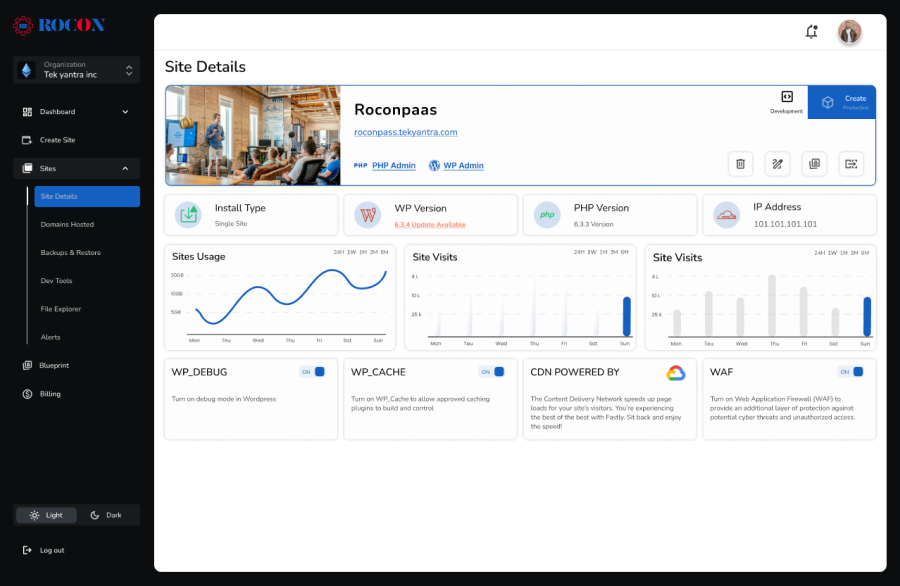
Starting price: $1.99/month. Predictable renewal pricing, no promotional bait-and-switch.
Rocon architecture is fundamentally different from SiteGround’s shared hosting. Each WordPress site runs inside its own isolated container with dedicated CPU and RAM. SiteGround puts your site on a shared server where hundreds of other sites compete for the same resources.
That container isolation is why Rocon can deliver sub-200ms global TTFB and 99.99% uptime SLA. On shared hosting, those numbers fluctuate based on what your server neighbors are doing. On Rocon’s containers, each site’s performance is independent.
Agencies managing 10+ client sites need isolation, not just separation. The multi-organization management system lets you group sites, set per-client access levels, and keep environments from interfering with each other.
SiteGround charges $30 per site for migrations beyond the first. Rocon handles unlimited migrations free. For an agency moving 15 client sites over, that’s $450 in savings on migration costs alone.
Best for: Agencies managing multiple client sites, WooCommerce stores, developers who need full server access, fast-growing startups that can’t afford hosting-induced downtime.

Starting price: $14/month on DigitalOcean. Pay-as-you-go pricing, no annual contracts.
Cloudways is a managed hosting platform that sits on top of real cloud infrastructure: AWS, Google Cloud, DigitalOcean, Vultr, and Linode. You pick the cloud provider and server size. Cloudways manages the software layer.
That model gives you something SiteGround can’t: actual dedicated resources and complete control over data center location. SiteGround runs on a single cloud provider with fixed data center options. Cloudways gives you 60+ data center locations across 5 major cloud providers.
Cloudways consistently benchmarks under 300ms global TTFB in independent testing. Combined with Cloudflare Enterprise CDN, users report sub-100ms TTFB in some configurations. SiteGround’s 632ms TTFB doesn’t compete at that level.
The platform is particularly well-suited for businesses that anticipate rapid growth but aren’t yet ready to manage infrastructure internally. It also supports Laravel, Magento, and custom PHP apps, making it more than just a WordPress solution.
A European software firm used Cloudways to host its Laravel app during an accelerator program. As their user base scaled from 1,000 to 20,000 users in 90 days, Cloudways’ flexible vertical scaling allowed them to upgrade their server size in under five minutes without migration hassles.
Best for: SaaS developers, early-stage startups, freelance developers managing multiple clients

Starting price: $30/month (1 WordPress site, 25,000 monthly visits, 10GB storage).
Kinsta runs on Google Cloud’s premium tier network. That has a specific technical meaning: traffic between your site and visitors routes through Google’s private fiber backbone before touching the public internet. Standard Google Cloud (which SiteGround uses) routes traffic through the public internet, which adds latency.
That infrastructure choice is why Kinsta consistently benchmarks under 200ms TTFB while SiteGround is at 632ms. It’s an architectural difference, not a tuning difference.
A nonprofit research institution in Boston hosts its library of academic papers on Kinsta. With over 3 million monthly page views, Kinsta’s C2 machines keep TTFB below 200ms. The site’s uptime in 2024 was 99.99%, and their team praised Kinsta’s dedicated WordPress engineers.
Best for: Large publishers, nonprofit organizations, universities, enterprise WordPress deployments
Starting price: $2.99/month. Turbo Boost plans from $6.99/month.
Hosting.com, formerly A2 Hosting, has been known for performance-focused shared hosting since 2001. The Turbo Boost tier uses LiteSpeed servers with NVMe storage and serves fewer accounts per server than standard shared hosting. That’s why performance holds up better than most budget hosts at similar price points.
The pricing math over 3 years on A2’s Turbo plan: roughly $251. SiteGround’s GrowBig over 3 years at renewal rates: roughly $1,080. That’s an $829 difference for comparable or better performance on shared hosting.
While the performance is competitive, A2’s user interface and support aren’t as polished as premium providers. Still, the cost savings can justify it for non-mission-critical sites.
Best for: Bloggers, small businesses, budget-conscious startups, developers working on short-term contracts

Starting price: $25/month (1 site, 10GB storage, 50GB bandwidth).
WP Engine built the managed WordPress hosting category and still leads it for enterprise use cases. The platform is exclusively WordPress, which means every infrastructure decision is optimized for WordPress performance.
The included Cloudflare Enterprise CDN is worth calling out specifically. Cloudflare Enterprise costs $200/month if purchased directly. At WP Engine you get it starting at $25/month. That single line item makes the pricing math interesting even against cheaper hosts.
WP Engine has tight restrictions on plugins, which could limit customization for more technical users. Traffic and storage caps are strict unless you move to their higher enterprise tiers.
Best for: Corporate websites, marketing teams, publishing platforms, and WooCommerce stores

Starting price: $2.95/month. Unmetered storage, unmetered bandwidth.
GreenGeeks offsets 300% of its energy consumption with Renewable Energy Certificates. Not net-zero: 3 times more renewable energy back into the grid than the company uses. For nonprofits, sustainable brands, or agencies whose clients have environmental commitments, that’s a real differentiator.
The sustainability angle doesn’t come at a performance cost. GreenGeeks runs LiteSpeed servers with NVMe SSD and built-in caching. In independent testing: 99.98% uptime, under 400ms global load times.
For sites with light-to-medium traffic that want to showcase their environmental credentials, GreenGeeks provides solid performance without compromising your mission.
Best for: Nonprofits, educators, sustainable brands, green tech startups

Starting price: $2.59/month on a 3-year plan.
DreamHost has been around for over 20 years in the WordPress hosting space, so it’s one of the most reliable and affordable alternatives to SiteGround.
If you’re thinking of using DreamHost as your next host, this is where the long-term value really becomes clear. For example, a 3-year Shared Starter plan is just $93.24, which is over $300 cheaper than SiteGround.
Over 5 years, it’s $261, over 10 years it’s $561, and over 20 years it’s $1300 in total hosting costs. So DreamHost is a smart choice for individuals and small businesses looking for steady long-term growth.
And it’s not just affordable, DreamHost delivers. You get unlimited traffic, 50GB SSD storage, and hosting for 1 WordPress site, perfect for blogs, portfolios, and small business sites. Plus a free domain for the first year and a simple control panel, so setup and management is easy even for beginners.
Best for: Freelancers, bloggers, small businesses planning long-term hosting without annual pricing renegotiation, anyone who wants WordPress.org’s endorsement behind their host choice.

Starting price: $4.50/month on 3-year billing (Baby Plan).
HostGator has been one of the most recognized budget hosting names since 2002. It’s built for users who want hosting to be invisible: set it up, install WordPress, and stop thinking about infrastructure.
Over 3 years on the Baby Plan: around $99 total. Even at HostGator’s renewal rates around $9.99/month, the long-term cost stays well below SiteGround’s renewal pricing.
HostGator runs Apache on most shared plans, not LiteSpeed. Apache is slower than LiteSpeed at identical hardware specs. Performance is adequate for low-traffic WordPress sites but benchmarks below A2 Hosting’s Turbo plans or GreenGeeks’ LiteSpeed stack.
Uptime is reliable. HostGator has a consistent track record of 99.9%+ uptime, which is better than SiteGround’s 2025 performance of 99.96%.
Best for: First websites, personal projects, small businesses where cost is the primary decision factor and traffic is modest.

Starting price: $3.49/month on a 2-year term.
InMotion has run U.S.-based hosting since 2001, with data centers in Ashburn, Virginia and Los Angeles, California. Support is U.S.-based, 24/7, by phone, live chat, and ticket. Users consistently report that agents give technically detailed answers rather than redirecting to documentation.
When comparing pricing, InMotion’s WordPress Hosting plans start at just $3.49 per month (for a 2-year term), which is still far cheaper than SiteGround’s entry-level plan.
Even better, InMotion’s renewal rates are far more transparent and predictable — you won’t face the steep post-discount jump that often frustrates SiteGround customers.
With plans designed for scalability, you can easily upgrade from a small personal site to a business-grade hosting plan without performance loss.
Best for: Small and medium businesses in the U.S., teams that prefer phone support, anyone migrating from SiteGround who wants a low-risk evaluation window.
Modern developers expect more from their hosting environments. Features like CI/CD pipelines, Git-based deployments, local development integration, staging environments, and scriptable interfaces are critical.
| Provider | Starting price | Renewal hike? | Architecture | Auto-scaling | Git access | Free migration | Best for |
|---|---|---|---|---|---|---|---|
| SiteGround | $3.99/mo | Yes. 351% jump. | Shared (Google Cloud) | No | GoGeek only | 1 site only | Simple small sites |
| Rocon | $1.99/mo | No | Container-based | Yes | All plans | Unlimited | Agencies, WooCommerce |
| Cloudways | $14/mo | No | Cloud VMs | Yes | All plans | Yes | Technical teams |
| Kinsta | $30/mo | No | Google Cloud Premium | Yes | All plans | Yes | High-traffic, performance |
| WP Engine | $25/mo | No | Google Cloud | Yes | All plans | Yes | Enterprise WordPress |
| A2 Hosting | $2.99/mo | Moderate | Shared (LiteSpeed) | No | All plans | Yes | Budget, dev projects |
| GreenGeeks | $2.95/mo | No | Shared (LiteSpeed) | No | All plans | Yes | Eco-focused brands |
| DreamHost | $2.59/mo | No | Shared | No | All plans | Yes | Long-term value |
| HostGator | $4.50/mo | Moderate | Shared (Apache) | No | Limited | Yes | Beginners |
| InMotion | $3.49/mo | No | Shared/VPS (LiteSpeed) | No | All plans | Yes | U.S. businesses |
The right answer depends on what specifically broke for you at SiteGround. Here’s how to match the problem to the solution.
DreamHost or GreenGeeks. Both have transparent, stable renewal pricing. DreamHost is WordPress.org recommended and cheaper over 5+ year horizons. GreenGeeks adds the sustainability angle if that matters.
Rocon or Cloudways. Rocon’s container architecture eliminates the noisy-neighbor CPU problem with automatic scaling. Cloudways gives you dedicated cloud resources where CPU is not shared.
Kinsta or WP Engine. Both run on Google Cloud infrastructure with TTFB benchmarks that SiteGround’s 632ms can’t match. Kinsta for pure speed. WP Engine if you also want Cloudflare Enterprise CDN and managed plugin updates built in.
Rocon for the combination of container isolation, unlimited free migrations, and multi-organization management. Cloudways if your team is technical and wants cloud provider flexibility.
WP Engine or Rocon. Both provide WordPress engineering support, not just server support. SiteGround explicitly removed WordPress problems from their support scope in 2020.
DreamHost at $2.59/month has the best long-term math. HostGator at $2.75/month is the cheapest entry point. A2 Hosting’s Turbo plans at $6.99/month give you LiteSpeed performance without premium managed hosting prices.
SiteGround built real credibility between 2015 and 2020. Fast servers, responsive support, clean interface. The WordPress.org recommendation was earned.
Since 2020: support scope shrank, TTFB degraded 57%, uptime slipped, and pricing got more aggressive at renewal. The product hasn’t kept pace with what you’re paying for it after year one.
Every SiteGround alternative on this list offers free migrations. The switching cost is lower than SiteGround’s pricing model relies on you believing.
Pick the one that fits your actual use case. Move the site. Stop renegotiating with a host that’s designed its pricing to make leaving feel harder than it is.
Three reasons drive most people to look elsewhere. First, renewal pricing: SiteGround plans jump 463% to 501% after the first billing cycle. Second, performance: TTFB degraded 57% between 2022 and 2025, and uptime dropped to 99.96% in 2025 with 193 minutes of total downtime. Third, support scope: SiteGround dropped WordPress-specific problems from official support coverage in 2020. For agencies, growing sites, or anyone running a business on WordPress, these issues compound over time.
Long-term, DreamHost has the best math at $2.59/month with stable renewal pricing. Over 10 years, DreamHost runs roughly $1,230 cheaper than SiteGround at comparable plan levels. For agencies needing container-based hosting at the lowest entry price, Rocon starts at $1.99/month with predictable renewals. HostGator’s $2.75/month Hatchling Plan is the cheapest absolute entry point for a basic WordPress site.
Kinsta and WP Engine consistently benchmark under 210ms TTFB on independent testing, compared to SiteGround’s 632ms in 2025. Both run on Google Cloud Premium Tier infrastructure. For container-based isolation that prevents the noisy-neighbor CPU problem entirely, Rocon delivers sub-200ms response times with automatic scaling on traffic spikes. SiteGround’s shared hosting throttles CPU during traffic surges, while these alternatives scale or isolate resources automatically.
For agencies, the key advantages are unlimited free migrations, full developer tools on every plan, container isolation between client sites, and multi-organization management for handling multiple clients in one dashboard. SiteGround works for agencies managing 1-3 simple sites; Rocon is built for agencies managing 10+ client sites with isolation and auto-scaling requirements.
The right competitor depends on what you need. For high-traffic sites, Kinsta or WP Engine. For agencies, Rocon or Cloudways. For long-term budget value, DreamHost. For sustainability, GreenGeeks. For U.S.-based support, InMotion. Each one addresses a different SiteGround weakness: pricing, performance, support scope, or developer flexibility. Match the alternative to the specific problem that pushed you to look in the first place.

Elevate your WordPress hosting with 30-day money-back guarantee, free migration, and 24/7 support.
Sign Up Today
September 28, 2026
Nitish
Before You Go… Get 1 Month FREE on Rocon Hosting!

Experience lightning-fast speeds

No downtime or hidden fees

Dedicated 24/7 expert support

Leave a Reply